Port Street Quality Growth Fund Fact Sheet :: as of 3/31/2018

Institutional Class Ticker: PSQGX (all data as of 3/31/2018)
CUSIP Number 56166Y529
Inception Date: 3/31/14
Minimum Initial Investment Class I
Standard Accounts $2,000
Traditional and Roth IRA Accounts $2,000
Accounts with Systematic Investment Plans $2,000
Beta: 0.48
Sharpe Ratio: 1.09
Active Share: 80.66%
Port Street Quality Growth Fund
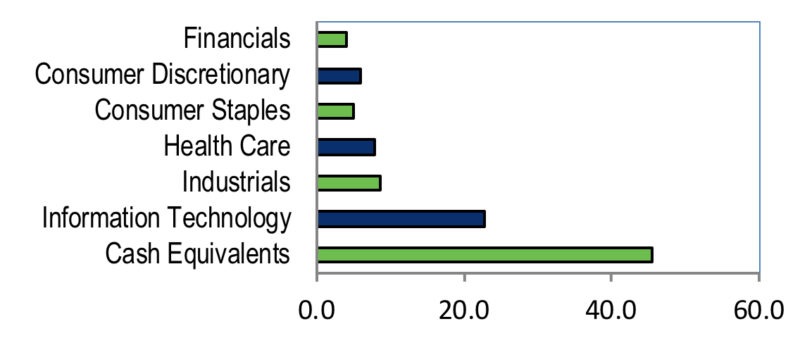
Sector Allocation% of net assets (as of 3/31/2018)
Information Technology: 22.8%
Industrials 8.7%
Health Care: 7.9%
Consumer Staples: 5.1%
Consumer Discretionary: 6.0%
Financials: 4.1%
Cash & Cash Equivalents: 45.4%
Top 5 Equity Holding % of net assets (as of 12/31/2017)
Berkshire Hathaway 4.1%
Apple Inc. 4.1%
United Tech Corporation 4.1%
Oracle Corp 4.0%
Cicso Systems Inc 3.5%
Active share: Active share is defined as the percentage of the portfolio that differs from its passive benchmark. For a long-only portfolio, the active share measure is between 0% and 100%. An active share measure of 0% indicates the portfolio is identical to its benchmark while a 100% active share measure indicates the portfolio has no overlap with its benchmark. (Source: William Blair) Only the benchmark-differentiating holdings can generate relative outperformance. (Source: MFS)
Beta: A statistic that measures the volatility of the fund, as compared to that of the overall market. The market’s beta is set at 1.00; a beta higher than 1.00 is considered to be more volatile than the market, while a beta lower than 1.00 is considered to be less volatile. Sharpe ratio: A statistical measure that uses standard deviation and excess return to determine reward per unit of risk. A higher Sharpe ratio implies a better historical risk-adjusted performance.
Sharpe ratio: A statistical measure that uses standard deviation and excess return to determine reward per unit of risk. A higher Sharpe ratio implies a better historical risk-adjusted performance.
Beta and Sharpe ratios are compared vs. Standard & Poor’s 500 (S&P 500) as index. S&P 500 is an index of 500 stocks chosen for market size, liquidity and industry grouping, among other factors. The S&P 500 is designed to be a leading indicator of U.S. equities and is meant to reflect the risk/return characteristics of the large cap universe.” One cannot invest in an index.
Fund holdings and sector allocations are subject to change and should not be considered a recommendation to buy or sell any security.
Systematic Investment Plans do not assure a profit, nor do they protect against a loss in a declining market.